




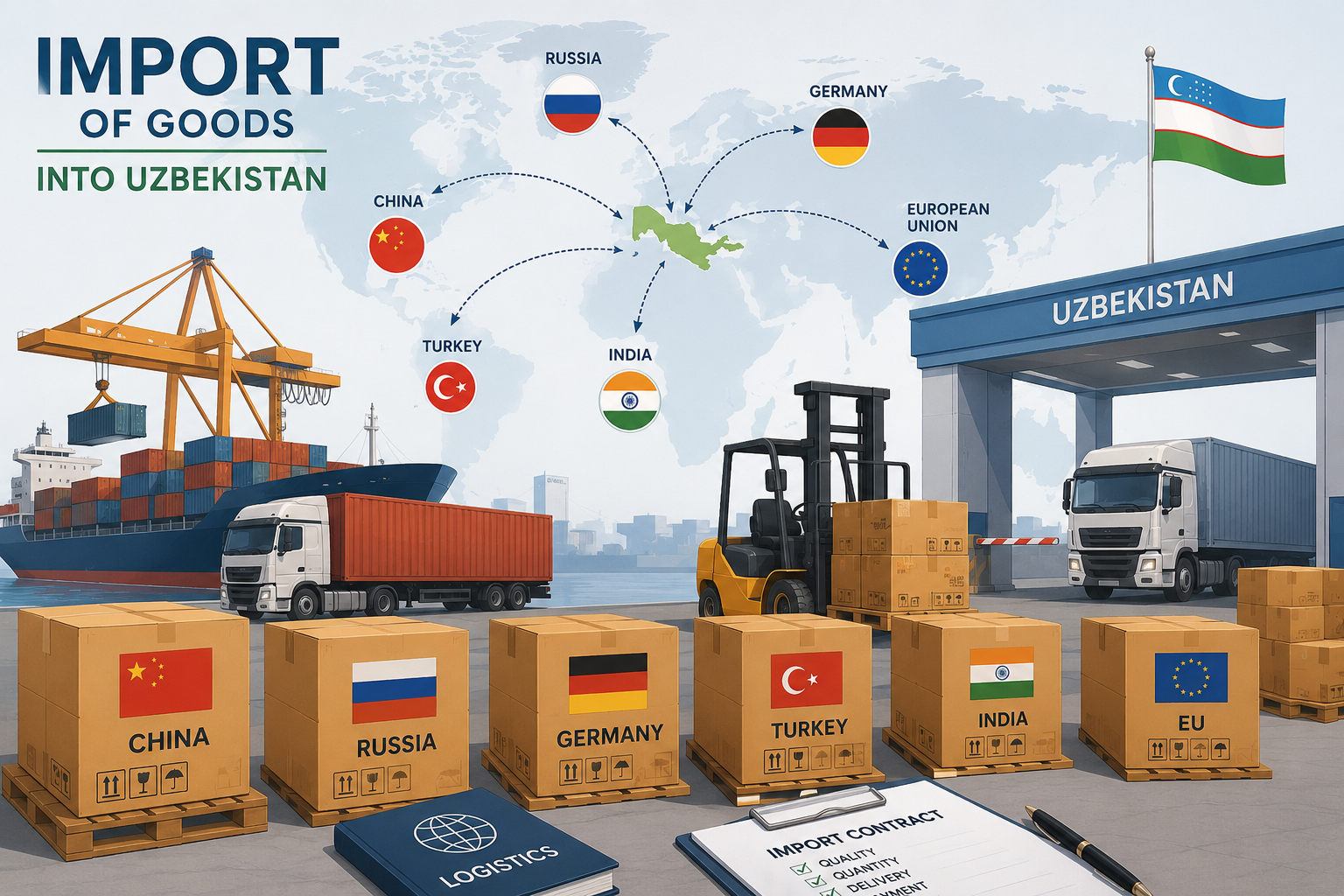
Importing Goods into Uzbekistan: Complete Guide for Foreign Companies
Uzbekistan is one of the fastest-growing import markets in Central Asia — and for foreign companies, navigating its customs system is one of the first practical challenges. The process is well-structured but document-heavy, runs in Russian and Uzbek, and requires a licensed intermediary at the declaration stage.
This guide covers the full picture: what customs clearance in Uzbekistan involves, what it costs, what documents you need, how the broker system works, and where things typically go wrong for first-time importers. For deeper dives into specific topics, we link to the relevant dedicated articles throughout.
UZ2B handles customs clearance end-to-end for foreign companies — from document preparation to on-site representation. Get a free consultation →
How Customs Clearance Works in Uzbekistan
Every commercial shipment entering Uzbekistan must be declared to the State Customs Committee before it can be released. There are no exceptions for foreign companies — whether you are importing raw materials, finished goods, equipment, or samples, the same process applies.
The clearance process runs through an electronic single window system. All declarations (called GTD — грузовая таможенная декларация) are submitted digitally, but the physical cargo sits in a bonded warehouse (СВХ — склад временного хранения) until the declaration is processed and duties are paid.
The standard clearance sequence
1.Cargo arrives at the border crossing or airport
2.Goods are placed in a bonded warehouse (СВХ) — storage fees begin immediately
3.Licensed customs declarant prepares and submits the GTD
4.Customs system assigns an inspection channel: green, yellow, or red
5.Green channel: declaration accepted, duties invoiced automatically
6.Yellow channel: document review — declarant responds with additional paperwork
7.Red channel: physical inspection of the cargo by customs officers
8.Duties and VAT are paid
9.Cargo is released from the bonded warehouse
Time in bonded warehouse: Storage fees at СВХ accumulate daily. Delays in document preparation or duty payment directly increase your clearance cost. This is the main reason foreign companies work with a local broker who can act immediately.
For a detailed breakdown of the declaration process and inspection channels, see: Customs Broker in Uzbekistan — What They Do and How UZ2B Can Help
Documents Required for Import Customs Clearance
The document package for customs clearance in Uzbekistan is standard for any CIS country, but completeness and accuracy matter — missing or incorrect documents are the most common cause of delays.
Core document package
•Commercial invoice — stating the price, quantity, and description of goods. Must match the contract exactly.
•Packing list — itemised breakdown of packaging, weights, and dimensions per unit.
•Contract — the purchase agreement between buyer and seller, with all relevant terms.
•Transport documents — CMR (road), AWB (air), Bill of Lading (sea), or railway waybill depending on the mode of transport.
•Certificate of origin — required for certain goods and essential for preferential duty rates under trade agreements.
•Technical documentation — for machinery, electronics, chemicals, food products — specifications, safety certificates, or conformity documents.
Additional documents depending on goods type
•Phytosanitary certificate — for agricultural products, plants, and food.
•Veterinary certificate — for animal products.
•Conformity certificate (sertifikat sootvetstviya) — for goods subject to mandatory certification in Uzbekistan.
•Licence or permit — for controlled goods: pharmaceuticals, chemicals, dual-use goods.
Certification note: Uzbekistan has its own mandatory certification system. Many product categories require a local conformity certificate before they can clear customs. UZ2B can advise on whether your goods require certification and coordinate the process through accredited partners.
Import Duties and Taxes
When importing into Uzbekistan, three main charges apply at customs:
1. Import customs duty
Rates vary by HS code (commodity classification). Most consumer goods attract duties of 5–30%. Some categories — including certain equipment, raw materials, and IT hardware — have zero or preferential rates. Uzbekistan applies the Harmonised System (HS) for classification.
2. VAT on import
Standard VAT rate in Uzbekistan is 12%. It is calculated on the customs value of the goods plus the import duty. VAT paid at customs is recoverable by VAT-registered companies against their output VAT.
3. Excise duty
Applies to specific categories: alcohol, tobacco, fuel, certain vehicles. Not applicable to most standard commercial goods.
Customs value: Duties and VAT are calculated on the CIF customs value (Cost + Insurance + Freight to the Uzbekistan border). Using the correct customs value is critical — undervaluation is a common compliance risk.
For detailed duty rates by product category and calculation examples, see: Import Duties and Customs Taxes in Uzbekistan
Why You Need a Licensed Customs Declarant
Customs declaration in Uzbekistan is a licensed activity. Only individuals and companies holding a valid licence issued by the State Customs Committee can submit declarations on behalf of third parties. This is not optional — an unlicensed intermediary cannot legally file a GTD for your shipment.
What the declarant handles
•HS code classification for your goods
•Calculating duties and VAT before the shipment arrives
•Preparing and submitting the GTD through the electronic single window
•Signing the bonded warehouse (СВХ) contract
•Responding to document requests in yellow channel cases
•Representing your company during red channel physical inspections
How UZ2B works
UZ2B coordinates licensed customs declarants and manages the full clearance process. You do not deal with the declarant directly — we are your single point of contact from document preparation through cargo release.
For a full breakdown of the broker's role and how channels work: Customs Broker in Uzbekistan — What They Do and How UZ2B Can Help
Import Routes into Uzbekistan
Uzbekistan is landlocked. All goods arrive by one of four routes, each with different transit times, costs, and practical considerations:
Road (auto transport)
•Main entry points: Gisht-Kuprik (from Kazakhstan), Dustlik, Oybek (from Tajikistan)
•Flexible for groupage (LCL) shipments and regional suppliers
•Most common route for imports from Turkey, Iran, China via Kazakhstan
Rail
•Major route for bulk goods and containers from China via Kazakhstan
•The China–Uzbekistan rail corridor has significantly reduced transit times
•Common for heavy goods, raw materials, and large commercial volumes
Air freight
•Tashkent International Airport — main air cargo hub
•Used for high-value, time-sensitive, or perishable goods
•Higher cost per kg but fastest clearance timeline
Multimodal (sea + rail or road)
•Common for goods from Europe, East Asia via ports of Novorossiysk, Bandar Abbas, or Chinese ports
•Requires transit customs procedures through Russia, Kazakhstan, or Iran
Common Mistakes That Delay Customs Clearance
Most clearance delays for foreign companies come from the same set of avoidable errors:
•Wrong or missing HS code. The HS code determines your duty rate and whether additional permits are required. An incorrect code can trigger a yellow or red channel review and delay release by days.
•Invoice price mismatch. The price on the commercial invoice must match the contract. Any discrepancy prompts customs to challenge the declared customs value.
•Missing certificate of origin. If your goods qualify for preferential duty under a trade agreement (e.g. CIS, SCO), but you lack the certificate, you pay the standard rate with no way to recover the difference after clearance.
•No local conformity certificate. For regulated product categories, arriving without the required Uzbekistan conformity certificate means the goods cannot clear customs — regardless of what documentation you have from the exporting country.
•Bonded warehouse delays. Waiting until goods arrive to start document preparation means you are paying storage fees while your declarant works. Preparation should begin before the shipment crosses the border.
•Working with an unlicensed intermediary. Any arrangement that involves an unlicensed person submitting a declaration creates legal exposure for the importer. Always verify your broker's licence.
What UZ2B Does for Importers
UZ2B provides end-to-end customs clearance support for foreign companies importing into Uzbekistan:
10. Pre-shipment consultation — HS code check, duty calculation, document checklist
11. Conformity certification advice — whether your goods require local certification and how to obtain it
12. Coordination of a licensed customs declarant — we manage the relationship, you have one contact point
13. GTD preparation and submission through the electronic system
14. Bonded warehouse (SVH) contract management
15. On-site representation for yellow and red channel cases
16. Duty and VAT payment coordination
17. Post-clearance accounting — duty costs correctly recorded in your Uzbekistan company’s books
We work with companies registered in Uzbekistan and with foreign companies importing on a one-time or ongoing basis. Contact us to discuss your shipment →
Frequently Asked Questions
Can a foreign company import goods into Uzbekistan without a local entity?
Yes — a foreign company can import goods without registering a local entity, but the customs declaration must still be filed by a licensed Uzbekistan-based declarant. UZ2B can coordinate this for companies that do not yet have a local registered LLC.
How long does customs clearance take?
Green channel: typically 1–2 business days after document submission. Yellow channel: 2–5 days depending on the complexity of the document review. Red channel: 3–7 days depending on the inspection schedule and the nature of the goods.
What is a bonded warehouse (SVH) and how long can goods stay there?
A bonded warehouse is a licensed customs storage facility where goods are held pending declaration. Goods may remain in SVH for up to 2 months (with extension possible up to 4 months in some cases). Storage fees vary by facility and cargo type — minimising time in SVH is a key part of cost management.
Do I need a certificate of origin for every shipment?
Not always — but if your goods are eligible for preferential duty rates under Uzbekistan's trade agreements (CIS, SCO, bilateral agreements), you will need a valid certificate of origin to claim those rates. Without it, standard MFN rates apply.
What is the VAT rate on imports?
The standard import VAT rate is 12%, calculated on the CIF customs value plus import duty. VAT-registered companies in Uzbekistan can recover this against their output VAT. Companies not yet registered for VAT cannot recover it.
Does UZ2B work with first-time importers?
Yes. Many of our clients are importing into Uzbekistan for the first time. We start with a pre-shipment consultation to review your goods, HS codes, document requirements, and expected costs — before anything moves.
Go Deeper: Related Articles
•Customs Broker in Uzbekistan — What They Do and How UZ2B Can Help
•Import Duties and Customs Taxes in Uzbekistan
•How to Register an LLC in Uzbekistan for Foreigners
•Opening a Bank Account in Uzbekistan for Foreign Companies
Author:
Jamshid Musakulov — UZ2B, Business Consulting Agency in Uzbekistan
Last updated: May 2026
Uzbekistan is one of the fastest-growing import markets in Central Asia — and for foreign companies, navigating its customs system is one of the first practical challenges. The process is well-structured but document-heavy, runs in Russian and Uzbek, and requires a licensed intermediary at the declaration stage.
This guide covers the full picture: what customs clearance in Uzbekistan involves, what it costs, what documents you need, how the broker system works, and where things typically go wrong for first-time importers. For deeper dives into specific topics, we link to the relevant dedicated articles throughout.
UZ2B handles customs clearance end-to-end for foreign companies — from document preparation to on-site representation. Get a free consultation →
How Customs Clearance Works in Uzbekistan
Every commercial shipment entering Uzbekistan must be declared to the State Customs Committee before it can be released. There are no exceptions for foreign companies — whether you are importing raw materials, finished goods, equipment, or samples, the same process applies.
The clearance process runs through an electronic single window system. All declarations (called GTD — грузовая таможенная декларация) are submitted digitally, but the physical cargo sits in a bonded warehouse (СВХ — склад временного хранения) until the declaration is processed and duties are paid.
The standard clearance sequence
1.Cargo arrives at the border crossing or airport
2.Goods are placed in a bonded warehouse (СВХ) — storage fees begin immediately
3.Licensed customs declarant prepares and submits the GTD
4.Customs system assigns an inspection channel: green, yellow, or red
5.Green channel: declaration accepted, duties invoiced automatically
6.Yellow channel: document review — declarant responds with additional paperwork
7.Red channel: physical inspection of the cargo by customs officers
8.Duties and VAT are paid
9.Cargo is released from the bonded warehouse
Time in bonded warehouse: Storage fees at СВХ accumulate daily. Delays in document preparation or duty payment directly increase your clearance cost. This is the main reason foreign companies work with a local broker who can act immediately.
For a detailed breakdown of the declaration process and inspection channels, see: Customs Broker in Uzbekistan — What They Do and How UZ2B Can Help
Documents Required for Import Customs Clearance
The document package for customs clearance in Uzbekistan is standard for any CIS country, but completeness and accuracy matter — missing or incorrect documents are the most common cause of delays.
Core document package
•Commercial invoice — stating the price, quantity, and description of goods. Must match the contract exactly.
•Packing list — itemised breakdown of packaging, weights, and dimensions per unit.
•Contract — the purchase agreement between buyer and seller, with all relevant terms.
•Transport documents — CMR (road), AWB (air), Bill of Lading (sea), or railway waybill depending on the mode of transport.
•Certificate of origin — required for certain goods and essential for preferential duty rates under trade agreements.
•Technical documentation — for machinery, electronics, chemicals, food products — specifications, safety certificates, or conformity documents.
Additional documents depending on goods type
•Phytosanitary certificate — for agricultural products, plants, and food.
•Veterinary certificate — for animal products.
•Conformity certificate (sertifikat sootvetstviya) — for goods subject to mandatory certification in Uzbekistan.
•Licence or permit — for controlled goods: pharmaceuticals, chemicals, dual-use goods.
Certification note: Uzbekistan has its own mandatory certification system. Many product categories require a local conformity certificate before they can clear customs. UZ2B can advise on whether your goods require certification and coordinate the process through accredited partners.
Import Duties and Taxes
When importing into Uzbekistan, three main charges apply at customs:
1. Import customs duty
Rates vary by HS code (commodity classification). Most consumer goods attract duties of 5–30%. Some categories — including certain equipment, raw materials, and IT hardware — have zero or preferential rates. Uzbekistan applies the Harmonised System (HS) for classification.
2. VAT on import
Standard VAT rate in Uzbekistan is 12%. It is calculated on the customs value of the goods plus the import duty. VAT paid at customs is recoverable by VAT-registered companies against their output VAT.
3. Excise duty
Applies to specific categories: alcohol, tobacco, fuel, certain vehicles. Not applicable to most standard commercial goods.
Customs value: Duties and VAT are calculated on the CIF customs value (Cost + Insurance + Freight to the Uzbekistan border). Using the correct customs value is critical — undervaluation is a common compliance risk.
For detailed duty rates by product category and calculation examples, see: Import Duties and Customs Taxes in Uzbekistan
Why You Need a Licensed Customs Declarant
Customs declaration in Uzbekistan is a licensed activity. Only individuals and companies holding a valid licence issued by the State Customs Committee can submit declarations on behalf of third parties. This is not optional — an unlicensed intermediary cannot legally file a GTD for your shipment.
What the declarant handles
•HS code classification for your goods
•Calculating duties and VAT before the shipment arrives
•Preparing and submitting the GTD through the electronic single window
•Signing the bonded warehouse (СВХ) contract
•Responding to document requests in yellow channel cases
•Representing your company during red channel physical inspections
How UZ2B works
UZ2B coordinates licensed customs declarants and manages the full clearance process. You do not deal with the declarant directly — we are your single point of contact from document preparation through cargo release.
For a full breakdown of the broker's role and how channels work: Customs Broker in Uzbekistan — What They Do and How UZ2B Can Help
Import Routes into Uzbekistan
Uzbekistan is landlocked. All goods arrive by one of four routes, each with different transit times, costs, and practical considerations:
Road (auto transport)
•Main entry points: Gisht-Kuprik (from Kazakhstan), Dustlik, Oybek (from Tajikistan)
•Flexible for groupage (LCL) shipments and regional suppliers
•Most common route for imports from Turkey, Iran, China via Kazakhstan
Rail
•Major route for bulk goods and containers from China via Kazakhstan
•The China–Uzbekistan rail corridor has significantly reduced transit times
•Common for heavy goods, raw materials, and large commercial volumes
Air freight
•Tashkent International Airport — main air cargo hub
•Used for high-value, time-sensitive, or perishable goods
•Higher cost per kg but fastest clearance timeline
Multimodal (sea + rail or road)
•Common for goods from Europe, East Asia via ports of Novorossiysk, Bandar Abbas, or Chinese ports
•Requires transit customs procedures through Russia, Kazakhstan, or Iran
Common Mistakes That Delay Customs Clearance
Most clearance delays for foreign companies come from the same set of avoidable errors:
•Wrong or missing HS code. The HS code determines your duty rate and whether additional permits are required. An incorrect code can trigger a yellow or red channel review and delay release by days.
•Invoice price mismatch. The price on the commercial invoice must match the contract. Any discrepancy prompts customs to challenge the declared customs value.
•Missing certificate of origin. If your goods qualify for preferential duty under a trade agreement (e.g. CIS, SCO), but you lack the certificate, you pay the standard rate with no way to recover the difference after clearance.
•No local conformity certificate. For regulated product categories, arriving without the required Uzbekistan conformity certificate means the goods cannot clear customs — regardless of what documentation you have from the exporting country.
•Bonded warehouse delays. Waiting until goods arrive to start document preparation means you are paying storage fees while your declarant works. Preparation should begin before the shipment crosses the border.
•Working with an unlicensed intermediary. Any arrangement that involves an unlicensed person submitting a declaration creates legal exposure for the importer. Always verify your broker's licence.
What UZ2B Does for Importers
UZ2B provides end-to-end customs clearance support for foreign companies importing into Uzbekistan:
10. Pre-shipment consultation — HS code check, duty calculation, document checklist
11. Conformity certification advice — whether your goods require local certification and how to obtain it
12. Coordination of a licensed customs declarant — we manage the relationship, you have one contact point
13. GTD preparation and submission through the electronic system
14. Bonded warehouse (SVH) contract management
15. On-site representation for yellow and red channel cases
16. Duty and VAT payment coordination
17. Post-clearance accounting — duty costs correctly recorded in your Uzbekistan company’s books
We work with companies registered in Uzbekistan and with foreign companies importing on a one-time or ongoing basis. Contact us to discuss your shipment →
Frequently Asked Questions
Can a foreign company import goods into Uzbekistan without a local entity?
Yes — a foreign company can import goods without registering a local entity, but the customs declaration must still be filed by a licensed Uzbekistan-based declarant. UZ2B can coordinate this for companies that do not yet have a local registered LLC.
How long does customs clearance take?
Green channel: typically 1–2 business days after document submission. Yellow channel: 2–5 days depending on the complexity of the document review. Red channel: 3–7 days depending on the inspection schedule and the nature of the goods.
What is a bonded warehouse (SVH) and how long can goods stay there?
A bonded warehouse is a licensed customs storage facility where goods are held pending declaration. Goods may remain in SVH for up to 2 months (with extension possible up to 4 months in some cases). Storage fees vary by facility and cargo type — minimising time in SVH is a key part of cost management.
Do I need a certificate of origin for every shipment?
Not always — but if your goods are eligible for preferential duty rates under Uzbekistan's trade agreements (CIS, SCO, bilateral agreements), you will need a valid certificate of origin to claim those rates. Without it, standard MFN rates apply.
What is the VAT rate on imports?
The standard import VAT rate is 12%, calculated on the CIF customs value plus import duty. VAT-registered companies in Uzbekistan can recover this against their output VAT. Companies not yet registered for VAT cannot recover it.
Does UZ2B work with first-time importers?
Yes. Many of our clients are importing into Uzbekistan for the first time. We start with a pre-shipment consultation to review your goods, HS codes, document requirements, and expected costs — before anything moves.
Go Deeper: Related Articles
•Customs Broker in Uzbekistan — What They Do and How UZ2B Can Help
•Import Duties and Customs Taxes in Uzbekistan
•How to Register an LLC in Uzbekistan for Foreigners
•Opening a Bank Account in Uzbekistan for Foreign Companies
Author:
Jamshid Musakulov — UZ2B, Business Consulting Agency in Uzbekistan
Last updated: May 2026


