




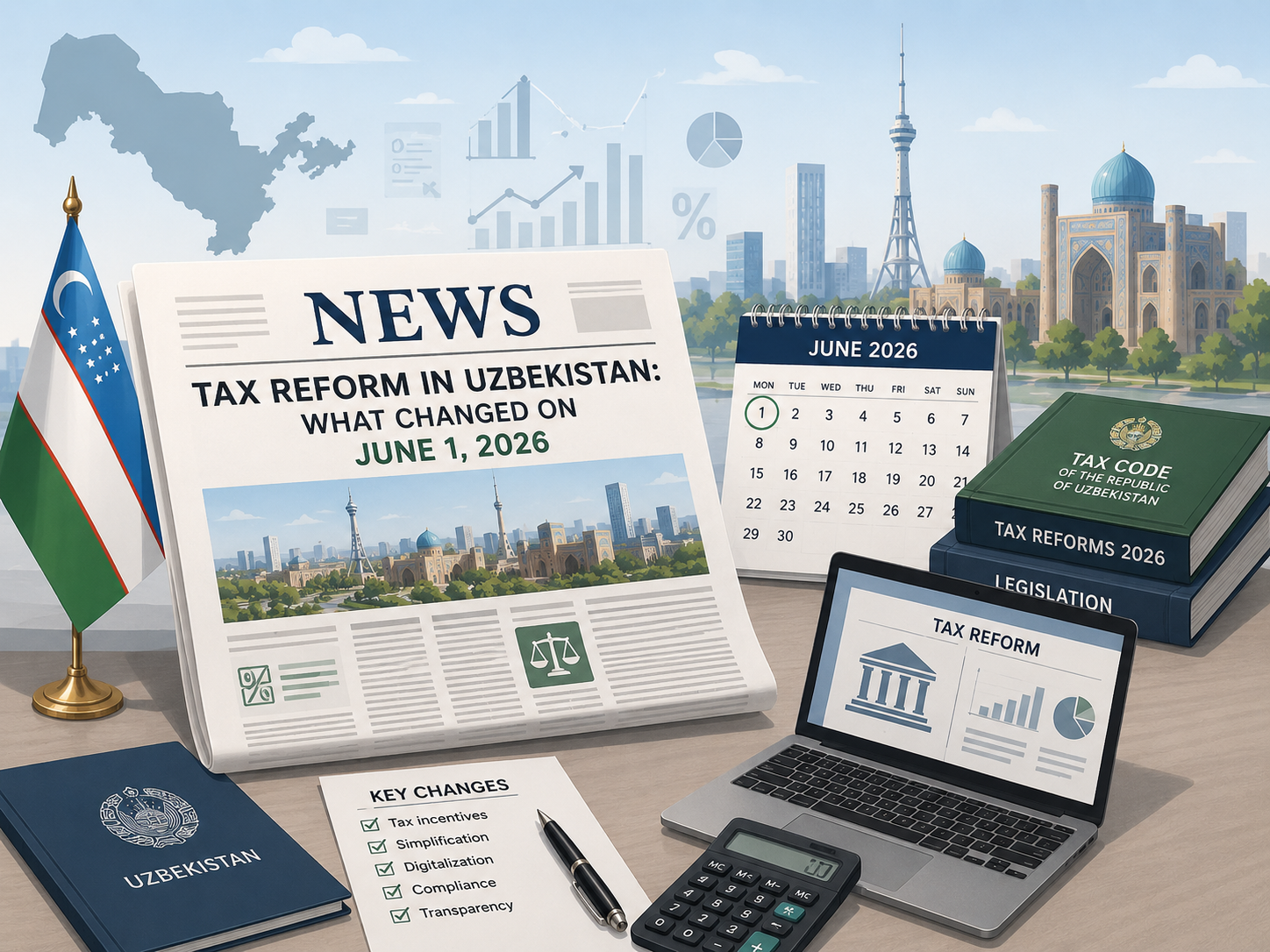
Uzbekistan Small Business Tax Reform: What Changed on 1 June 2026
On 29 May 2026, President Mirziyoyev signed a decree introducing the most significant simplification of Uzbekistan's small business tax regime in recent years. The changes took effect on 1 June 2026 — this week.
This article breaks down each change, explains who it applies to, and outlines what it means specifically for foreign-owned companies registered in Uzbekistan.
Overview: Five Changes That Matter
Effective date: 1 June 2026. Applicable to: small and medium businesses registered in Uzbekistan, including those with 100% foreign ownership, unless the state holds 50%+ of the company.
•Simplified VAT at 6% (vs. standard 12%) — voluntary regime available until 1 January 2030
•Higher threshold for mandatory transition to the general tax system — raised to 12,000 base calculation units
•Automatic VAT refunds up to 10 million soums — no application, no audit required
•Tax audit moratorium for small businesses — suspended until 2028 for most risk levels
•Double deduction for accountant and tax consultant fees — from 2027
Change 1: Simplified VAT Regime at 6%
The standard VAT rate in Uzbekistan is 12%. From 1 June 2026, eligible small businesses in trade, services, and food service can voluntarily switch to a simplified VAT regime with a rate of 6% applied to total turnover.
What the simplified regime includes
•VAT rate: 6% of total revenue from goods and services
•Profit tax: 0% — zeroed out entirely under this regime
•No profit tax reporting — the obligation to file profit tax returns is removed
•Duration: available until 1 January 2030
What it does not include
•No VAT input credit — VAT paid on purchases cannot be offset against VAT collected
•Not available to companies with 50%+ state ownership
•Not available to large taxpayers
Practical implication for foreign-owned companies: if your Uzbekistan company is in the early stages and has limited input VAT to reclaim, the simplified regime may be significantly more attractive than the standard system. You pay 6% of revenue, zero profit tax, and file less paperwork. This is particularly relevant for service companies, consultancies, and trading companies with high margins.
Important: the choice between standard and simplified VAT is voluntary and strategic. UZ2B can help you calculate which regime produces a lower effective tax burden for your specific business model before you register.
Change 2: Higher Threshold for General Tax System
Previously, companies crossing a certain revenue threshold were automatically required to switch from the simplified tax system to the general (standard) tax system — which involves higher rates, more complex accounting, and full VAT at 12%.
The decree raises this threshold to 12,000 base calculation units (BCU). As of 2026, one BCU in Uzbekistan equals 375,000 soums, making the threshold approximately 4.5 billion soums — or roughly $350,000–$400,000 in annual revenue.
What this means: more companies can remain on the simplified tax system for longer. If your foreign-owned company is in the growth phase, you have more runway before the administrative and tax burden of the general system kicks in.
Change 3: Automatic VAT Refunds
One of the persistent friction points for businesses in Uzbekistan has been the VAT refund process — historically slow, paper-heavy, and requiring an audit before any refund was issued.
What changed immediately (June 2026)
•Negative VAT balances of up to 10 million soums accumulated before the decree will be refunded automatically
•No application required
•No audit required for this initial round
What changes from 2027
•The Tax Committee and Ministry of Economy must implement a real-time automated VAT refund system by 1 October 2026
•From 2027, the entire refund process for low-risk taxpayers will be fully automated — no human involvement
For foreign-owned companies: if your company has accumulated a negative VAT balance, check with your accountant whether you qualify for the automatic refund. This is particularly relevant for companies that import goods or services and pay VAT at customs.
Change 4: Tax Audit Moratorium Until 2028
The decree introduces a de facto moratorium on tax audits for small businesses:
•Tax risk below 500 million soums: no tax audit will be conducted — self-correction is allowed instead
•Tax risk below 100 million soums: no field inspection (выездная проверка) will be conducted
•Valid until: 1 January 2028
What self-correction means: if a tax risk is identified, the business can correct it independently without triggering a formal audit. This removes a significant source of uncertainty and cost for small business owners.
For foreign-owned companies: this is one of the most practically significant changes. The prospect of tax audits is a major deterrent for foreign entrepreneurs. A two-year moratorium for most risk levels materially reduces that exposure.
Change 5: Double Deduction for Accounting and Tax Advisory Costs
From 1 January 2027, small businesses can deduct expenses for hiring accountants and tax consultants at twice the actual amount paid.
Example: if you pay 5 million soums per month for accounting outsourcing (60 million per year), you can deduct 120 million soums from your taxable income — effectively making professional accounting free from a tax perspective.
This change directly incentivises small businesses to work with professional accountants rather than managing compliance informally — which reduces errors and audit risk over time.
Who This Applies To — and Who It Doesn’t
Applies to
•Small businesses registered in Uzbekistan, including LLCs with 100% foreign ownership
•Companies in trade, services, food service, and most commercial sectors
•Companies below the large taxpayer threshold
Does not apply to
•Companies where the state owns 50% or more
•Large taxpayers (specific turnover/asset thresholds defined by the Tax Committee)
•Companies already on the general tax system that do not meet eligibility criteria for the simplified VAT regime
What This Means for Registering a New Company in Uzbekistan
The June 2026 reform makes Uzbekistan materially more attractive for foreign entrepreneurs who are considering registering a company here. Specifically:
•Lower effective tax rate in Year 1–4: 6% VAT on revenue + zero profit tax is significantly lower than the standard regime for most service and trading businesses
•Less compliance burden: no profit tax reporting, simplified VAT filing, audit moratorium until 2028
•Predictability: the simplified regime runs until 2030 — four years of stable, low-complexity tax treatment
•Professional support is incentivised: double deduction for accounting costs from 2027 makes outsourcing your accounting to UZ2B effectively tax-deductible at 2×
If you have been considering registering a company in Uzbekistan — the window between now and 2027 is the most favourable tax environment the country has offered for new foreign-owned businesses. The simplified VAT regime, audit moratorium, and zero profit tax create a low-risk, low-cost first chapter for your Uzbekistan operation.
UZ2B registers companies in Uzbekistan for foreign entrepreneurs — remotely, from anywhere. We handle the full process: LLC registration, bank account, accounting setup, and tax regime selection. We will advise you on whether the simplified or standard VAT regime makes more sense for your specific business model before you commit.
Register your company in Uzbekistan under the new tax regime →
Frequently Asked Questions
Does the simplified VAT regime apply to my company if I am a foreigner?
Yes, provided your company is registered in Uzbekistan as an LLC (OOO) with foreign ownership and meets the eligibility criteria (not state-owned, not a large taxpayer). The simplified regime is available regardless of the nationality of the founders. UZ2B can register your LLC remotely.
Can I switch to the simplified VAT regime if my company is already registered?
Yes — the regime is voluntary, and existing companies can elect to switch. The transition procedure requires a notification to the tax authority. UZ2B can handle this as part of ongoing accounting support.
What happens after 2030 when the simplified regime ends?
The decree runs until 1 January 2030. After that, businesses on the simplified regime will transition back to the standard system unless the regime is extended. Given the direction of Uzbekistan's tax policy, an extension is possible — but cannot be guaranteed. Plan for a transition in 2029.
How does the audit moratorium work in practice?
Until 1 January 2028, if the Tax Committee identifies a tax risk below 500 million soums in your company, they will notify you and give you the opportunity to self-correct rather than initiating an audit. For risks below 100 million soums, no field inspection will be conducted at all.
Does UZ2B help with choosing the right tax regime?
Yes. When registering a new company, UZ2B reviews your planned business activity, expected revenue, and cost structure to recommend the optimal tax regime from day one. Contact us for a free initial consultation →
Related Articles
•How to Register an LLC in Uzbekistan for Foreigners
•Taxation in Uzbekistan for Foreigners 2026
•Corporate Services in Uzbekistan
•Bookkeeping and Accounting in Uzbekistan
•Opening a Bank Account in Uzbekistan
Author:
Jamshid Musakulov — UZ2B, Business Consulting Agency in Uzbekistan
Last updated: June 2026
On 29 May 2026, President Mirziyoyev signed a decree introducing the most significant simplification of Uzbekistan's small business tax regime in recent years. The changes took effect on 1 June 2026 — this week.
This article breaks down each change, explains who it applies to, and outlines what it means specifically for foreign-owned companies registered in Uzbekistan.
Overview: Five Changes That Matter
Effective date: 1 June 2026. Applicable to: small and medium businesses registered in Uzbekistan, including those with 100% foreign ownership, unless the state holds 50%+ of the company.
•Simplified VAT at 6% (vs. standard 12%) — voluntary regime available until 1 January 2030
•Higher threshold for mandatory transition to the general tax system — raised to 12,000 base calculation units
•Automatic VAT refunds up to 10 million soums — no application, no audit required
•Tax audit moratorium for small businesses — suspended until 2028 for most risk levels
•Double deduction for accountant and tax consultant fees — from 2027
Change 1: Simplified VAT Regime at 6%
The standard VAT rate in Uzbekistan is 12%. From 1 June 2026, eligible small businesses in trade, services, and food service can voluntarily switch to a simplified VAT regime with a rate of 6% applied to total turnover.
What the simplified regime includes
•VAT rate: 6% of total revenue from goods and services
•Profit tax: 0% — zeroed out entirely under this regime
•No profit tax reporting — the obligation to file profit tax returns is removed
•Duration: available until 1 January 2030
What it does not include
•No VAT input credit — VAT paid on purchases cannot be offset against VAT collected
•Not available to companies with 50%+ state ownership
•Not available to large taxpayers
Practical implication for foreign-owned companies: if your Uzbekistan company is in the early stages and has limited input VAT to reclaim, the simplified regime may be significantly more attractive than the standard system. You pay 6% of revenue, zero profit tax, and file less paperwork. This is particularly relevant for service companies, consultancies, and trading companies with high margins.
Important: the choice between standard and simplified VAT is voluntary and strategic. UZ2B can help you calculate which regime produces a lower effective tax burden for your specific business model before you register.
Change 2: Higher Threshold for General Tax System
Previously, companies crossing a certain revenue threshold were automatically required to switch from the simplified tax system to the general (standard) tax system — which involves higher rates, more complex accounting, and full VAT at 12%.
The decree raises this threshold to 12,000 base calculation units (BCU). As of 2026, one BCU in Uzbekistan equals 375,000 soums, making the threshold approximately 4.5 billion soums — or roughly $350,000–$400,000 in annual revenue.
What this means: more companies can remain on the simplified tax system for longer. If your foreign-owned company is in the growth phase, you have more runway before the administrative and tax burden of the general system kicks in.
Change 3: Automatic VAT Refunds
One of the persistent friction points for businesses in Uzbekistan has been the VAT refund process — historically slow, paper-heavy, and requiring an audit before any refund was issued.
What changed immediately (June 2026)
•Negative VAT balances of up to 10 million soums accumulated before the decree will be refunded automatically
•No application required
•No audit required for this initial round
What changes from 2027
•The Tax Committee and Ministry of Economy must implement a real-time automated VAT refund system by 1 October 2026
•From 2027, the entire refund process for low-risk taxpayers will be fully automated — no human involvement
For foreign-owned companies: if your company has accumulated a negative VAT balance, check with your accountant whether you qualify for the automatic refund. This is particularly relevant for companies that import goods or services and pay VAT at customs.
Change 4: Tax Audit Moratorium Until 2028
The decree introduces a de facto moratorium on tax audits for small businesses:
•Tax risk below 500 million soums: no tax audit will be conducted — self-correction is allowed instead
•Tax risk below 100 million soums: no field inspection (выездная проверка) will be conducted
•Valid until: 1 January 2028
What self-correction means: if a tax risk is identified, the business can correct it independently without triggering a formal audit. This removes a significant source of uncertainty and cost for small business owners.
For foreign-owned companies: this is one of the most practically significant changes. The prospect of tax audits is a major deterrent for foreign entrepreneurs. A two-year moratorium for most risk levels materially reduces that exposure.
Change 5: Double Deduction for Accounting and Tax Advisory Costs
From 1 January 2027, small businesses can deduct expenses for hiring accountants and tax consultants at twice the actual amount paid.
Example: if you pay 5 million soums per month for accounting outsourcing (60 million per year), you can deduct 120 million soums from your taxable income — effectively making professional accounting free from a tax perspective.
This change directly incentivises small businesses to work with professional accountants rather than managing compliance informally — which reduces errors and audit risk over time.
Who This Applies To — and Who It Doesn’t
Applies to
•Small businesses registered in Uzbekistan, including LLCs with 100% foreign ownership
•Companies in trade, services, food service, and most commercial sectors
•Companies below the large taxpayer threshold
Does not apply to
•Companies where the state owns 50% or more
•Large taxpayers (specific turnover/asset thresholds defined by the Tax Committee)
•Companies already on the general tax system that do not meet eligibility criteria for the simplified VAT regime
What This Means for Registering a New Company in Uzbekistan
The June 2026 reform makes Uzbekistan materially more attractive for foreign entrepreneurs who are considering registering a company here. Specifically:
•Lower effective tax rate in Year 1–4: 6% VAT on revenue + zero profit tax is significantly lower than the standard regime for most service and trading businesses
•Less compliance burden: no profit tax reporting, simplified VAT filing, audit moratorium until 2028
•Predictability: the simplified regime runs until 2030 — four years of stable, low-complexity tax treatment
•Professional support is incentivised: double deduction for accounting costs from 2027 makes outsourcing your accounting to UZ2B effectively tax-deductible at 2×
If you have been considering registering a company in Uzbekistan — the window between now and 2027 is the most favourable tax environment the country has offered for new foreign-owned businesses. The simplified VAT regime, audit moratorium, and zero profit tax create a low-risk, low-cost first chapter for your Uzbekistan operation.
UZ2B registers companies in Uzbekistan for foreign entrepreneurs — remotely, from anywhere. We handle the full process: LLC registration, bank account, accounting setup, and tax regime selection. We will advise you on whether the simplified or standard VAT regime makes more sense for your specific business model before you commit.
Register your company in Uzbekistan under the new tax regime →
Frequently Asked Questions
Does the simplified VAT regime apply to my company if I am a foreigner?
Yes, provided your company is registered in Uzbekistan as an LLC (OOO) with foreign ownership and meets the eligibility criteria (not state-owned, not a large taxpayer). The simplified regime is available regardless of the nationality of the founders. UZ2B can register your LLC remotely.
Can I switch to the simplified VAT regime if my company is already registered?
Yes — the regime is voluntary, and existing companies can elect to switch. The transition procedure requires a notification to the tax authority. UZ2B can handle this as part of ongoing accounting support.
What happens after 2030 when the simplified regime ends?
The decree runs until 1 January 2030. After that, businesses on the simplified regime will transition back to the standard system unless the regime is extended. Given the direction of Uzbekistan's tax policy, an extension is possible — but cannot be guaranteed. Plan for a transition in 2029.
How does the audit moratorium work in practice?
Until 1 January 2028, if the Tax Committee identifies a tax risk below 500 million soums in your company, they will notify you and give you the opportunity to self-correct rather than initiating an audit. For risks below 100 million soums, no field inspection will be conducted at all.
Does UZ2B help with choosing the right tax regime?
Yes. When registering a new company, UZ2B reviews your planned business activity, expected revenue, and cost structure to recommend the optimal tax regime from day one. Contact us for a free initial consultation →
Related Articles
•How to Register an LLC in Uzbekistan for Foreigners
•Taxation in Uzbekistan for Foreigners 2026
•Corporate Services in Uzbekistan
•Bookkeeping and Accounting in Uzbekistan
•Opening a Bank Account in Uzbekistan
Author:
Jamshid Musakulov — UZ2B, Business Consulting Agency in Uzbekistan
Last updated: June 2026


